The Role of Data in Driving a Unified and Scalable Agri Ecosystem in India
June 24, 2026
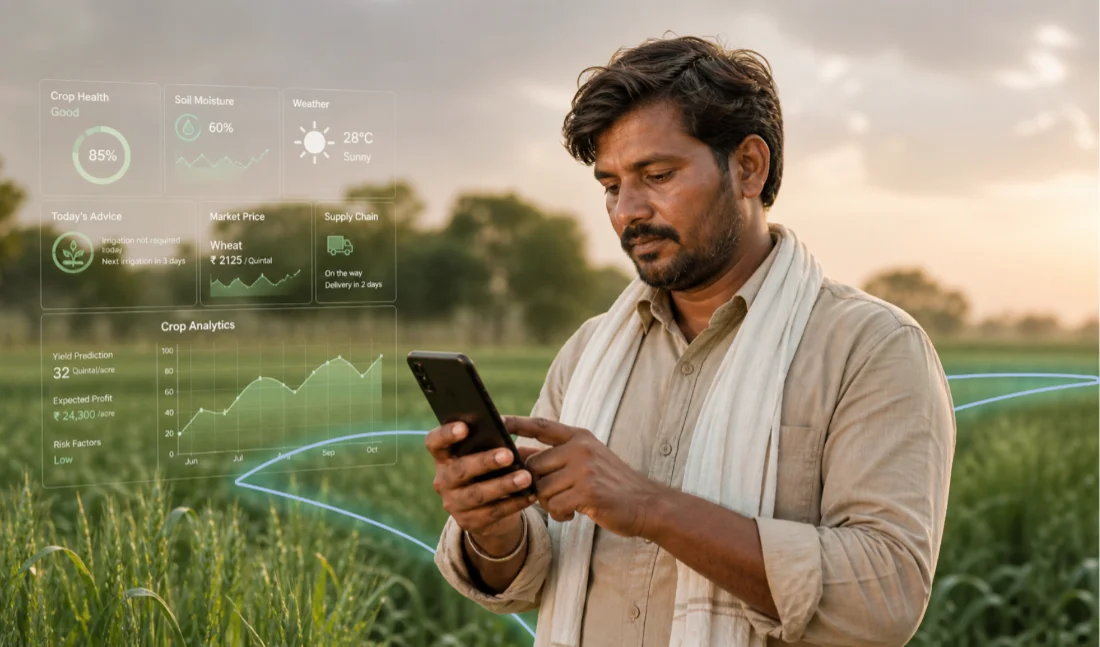
India’s agriculture sector employs nearly half the country’s workforce and contributes approximately 18% of GDP - yet it remains one of the most structurally fragmented industries in the world. Smallholder farmers, who account for 86% of all cultivators, operate on less than two hectares of land on average. They sell into opaque, middleman-dominated markets. They borrow at exploitative rates. They absorb climate shocks with no financial cushion. And they make critical decisions - on seeds, inputs, harvests - based on word-of-mouth rather than data.
This structural fragmentation highlights some of the biggest challenges in Indian agriculture supply chain, where inefficiencies persist across sourcing, pricing, logistics, and market access. Across the agri supply chain India, the gap between production and consumption is riddled with inefficiencies: post-harvest losses estimated at 15–20% of total output, limited cold-chain infrastructure, a near-total absence of formal credit for agri traders and processors, and a market linkage system that consistently undervalues the farmer’s produce. These are not new problems. But data - and the platforms that deploy it intelligently - are finally creating a pathway to fix them.
From Data Points to Decision Intelligence
Recent government priorities, underscored in Union Budget 2026, reflect a serious commitment to AI-driven agricultural intelligence - a key pillar of digital agriculture India - drawing from soil health databases, weather station networks, satellite imagery, and crop monitoring systems to deliver real-time advisories across the farming cycle. The intent is clear: move farmers from reactive to proactive decision-making through data-driven agriculture India.
But intent and execution are two different things. The infrastructure being built at the national level - the AgriStack, the Unified Farmer Service Interface, digital crop surveys - is foundational for agri value chain digitization. Industry estimates suggest it could unlock $65 billion in value across the sector. However, these systems are only as powerful as the last-mile layer that translates them into farmer behaviour and buyer action. And that layer is where the real gap still exists.
Consider what it actually means when we talk about how data is transforming agriculture in India. Applying precision agriculture in a district in eastern Uttar Pradesh or interior Maharashtra goes beyond insights. A farmer with a smartphone may receive a push notification about pest risk in their crop. But if there is no aggregation partner to connect that farmer to a quality input supplier, no credit mechanism to fund the purchase, and no reliable offtake channel for the harvest - the data insight has no commercial value. The ecosystem is broken at the transaction layer.
The Execution Gap
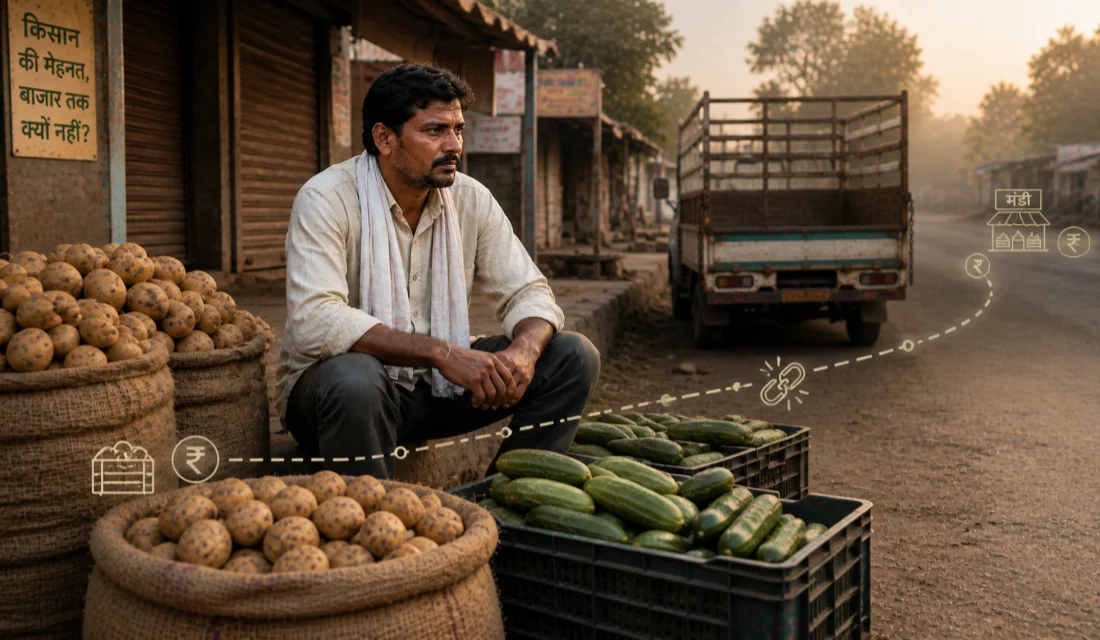
The agritech conversation in India - especially around Agritech India 2026 - has matured significantly, but it has also remained largely theoretical. Most platforms today are strong on analytics and weak on execution. They can tell a farmer when to sow; they cannot guarantee where the harvest will sell. They can score a borrower’s creditworthiness; they cannot disburse the loan in time for the next crop cycle. They can map supply and demand; they cannot move the produce.
The real infrastructure gap in Indian agriculture is not data collection - it is data-to-commerce translation. This means converting insights into actual transactions: procurement orders, working capital disbursements, input procurement, and logistics coordination. Without this layer, the ecosystem remains fragmented regardless of how sophisticated the analytics become.
There is also a geography problem. Most agritech innovation is designed for and deployed in relatively accessible markets - irrigated belts, well-connected mandis, farmers with moderate digital literacy. The Bharat reality - remote mandis, first-generation smartphone users, oral-culture trading norms, informal credit dependency - demands a different approach. One that meets the market where it is, not where we wish it were.
Ayekart: Building the Commerce and Credit Layer
This is where Ayekart operates. As a B2B agri commerce platform, Ayekart is not just observing the transformation of digital agriculture India - it is building the transactional infrastructure that makes that transformation commercially viable.
At its core, Ayekart connects agri supply chains: linking smallholder farmers and farmer producer organisations (FPOs) to institutional buyers, processors, and FMCG companies. This directly strengthens farmer market linkages in India and improves demand visibility across the ecosystem.
Supply chain enablement: Ayekart uses transaction and sourcing data to build visibility across produce flows - tracking what is being grown, where, in what volumes, and at what quality parameters. This strengthens the agri supply chain in India, allowing institutional buyers to plan procurement with confidence rather than scrambling at mandis. It also enables better access to the FPO market in India, connecting producer groups to structured demand.
Embedded financing: One of the most persistent failures in agri supply chains is the working capital gap. Traders, aggregators, and FPOs are cash-constrained precisely when they need to move produce fastest. Ayekart integrates financing directly into the commerce workflow - enabling credit disbursement at the point of transaction, backed by real trade data rather than traditional collateral. In Tier 2 and Tier 3 markets, this is transformative.
Market linkages: Data on demand patterns, price trends, and buyer preferences - which, at the national level feeds into dashboards - at Ayekart feeds into actual purchase orders. The platform creates structured, recurring market linkages between buyers and seller networks, significantly improving farmer market linkages in India and reducing reliance on fragmented spot markets.
This is not agritech in the abstract. It is agri-commerce with intelligence embedded at every step.
The Tier 2/3 Reality: Why Ground-Level Execution Matters
Any platform claiming to transform Indian agriculture needs to answer one question honestly: does it work in Bhilwara? In Nanded? In Muzaffarpur? Because the majority of India’s agri output - and the majority of its structural inefficiency - sits in exactly these geographies.
In Tier 2 and Tier 3 markets, several realities hold. Trust is built through relationships, not apps. Credit decisions happen over phone calls, not portals. Produce quality is assessed by touch and smell, not just sensor data. Logistics is improvised. These are not barriers to technology adoption - they are design constraints that technology must work within.
Ayekart’s model is built with these realities in mind. Rather than assuming digital fluency, it layers technology over existing trade relationships and workflows. Rather than replacing informal credit with formal credit overnight, it builds a data trail that progressively formalises borrowing behaviour. Rather than demanding that smallholders transact directly on a platform, it works through aggregators and FPOs who already have farmer trust - further enabling FPO market access in India at scale.
A Unified Ecosystem: Data Must Drive Commerce, Not Just Conversation
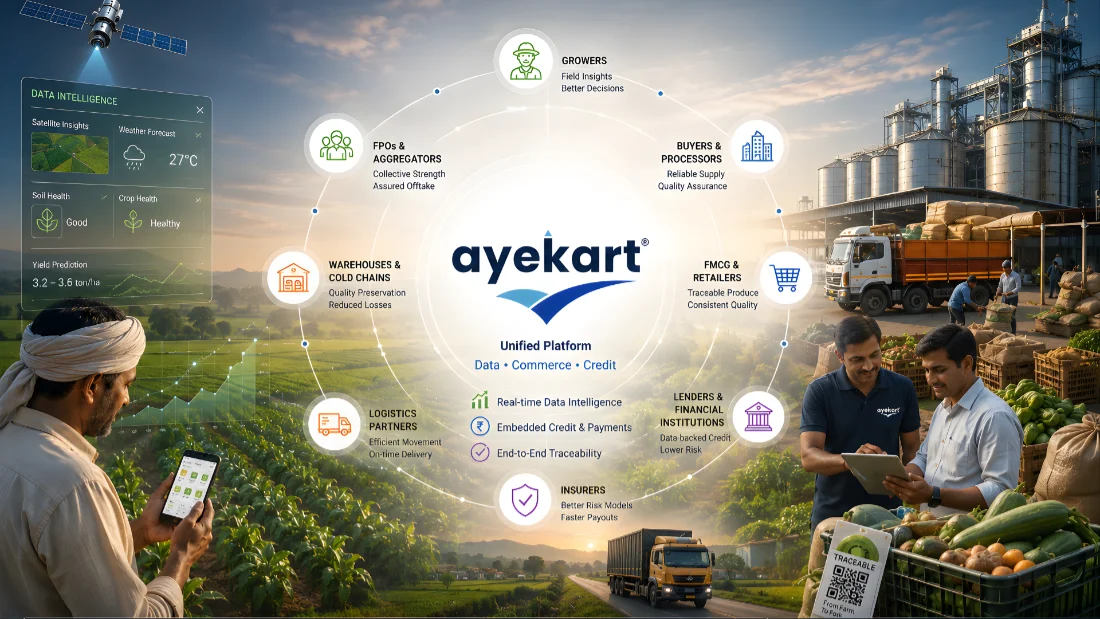
India’s agri ecosystem will not be unified by data alone. It will be unified by platforms that translate data into commercial outcomes - better prices, faster payments, reliable supply, accessible credit. The predictive models, the satellite imagery, and the parametric insurance frameworks being built at the macro level are genuinely powerful. But their value is only realised when they connect to the transaction layer.
Industry estimates point to record grain output in 2025/26 and growing institutional appetite for traceable, quality-assured agri produce. The infrastructure to capture this opportunity - the cold chains, the FPO networks, the rural digital payment rails - is being built. What is needed now is the commerce and credit platform that sits at the centre: routing supply to demand, financing the gap, and doing so at Bharat scale.
The federated ecosystem that Indian agriculture needs - linking growers, aggregators, buyers, insurers, and lenders through shared data - requires an enabler, not just an observer. It requires a platform with operational presence, financial tooling, and last-mile reach to make the ecosystem function as a whole rather than a collection of disconnected parts.
The transformation of Indian agriculture is underway. Data is the foundation. But foundations don’t feed people or build businesses - what gets built on them does.
Ayekart’s position is clear: the most critical infrastructure in Indian agriculture today is not the next analytics dashboard or the next satellite layer. It is the commerce and credit infrastructure that makes the entire data ecosystem commercially productive - that converts insight into income for farmers, efficiency into margin for buyers, and risk into opportunity for lenders.
For India to build a truly unified, scalable agri ecosystem, the country needs platforms that operate across the full value chain - from farm to fork, from field insight to financing - with the ground-level discipline to make it work in every district, not just the easy ones.
